







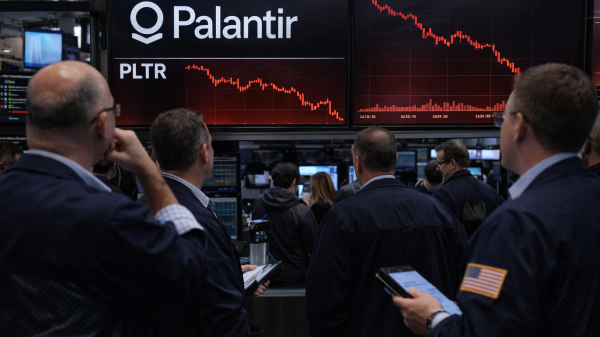





Wall Street took a step back Friday after a weaker-than-expected GDP reading injected fresh doubt into the “resilient growth” story investors had been leaning on.
The Dow Jones Industrial Average slipped 166 points, or 0.3%.
The S&P 500 hovered near unchanged levels, while the Nasdaq Composite edged up 0.2%, supported by a 2% advance in Alphabet stock.
US output in the fourth quarter expanded at an annualized 1.4% pace, well below forecasts for about 2.5%, with the government shutdown cited as a key drag through reduced federal outlays.
The mood was cautious rather than panicked: traders weren’t pricing a recession, but they were marking down confidence in how smoothly the economy would carry into 2026.
Weak GDP clouds the growth outlook
The headline number did the damage because it wasn’t just a miss; it was a sharp downshift from the prior quarter’s pace.
The 1.4% pace represented a steep slowdown from 4.4% in the third quarter, with a wider trade deficit and the historic shutdown weighing on growth.
The shutdown’s hit to federal expenditures was cited as a key drag, framing the GDP disappointment as partly a one-off shock rather than a broad collapse in private demand.
That nuance is why Friday’s pullback looked like recalibration, not capitulation.
The data still showed growth, but it challenged a market narrative that had been pricing in durability, steady consumers, stable corporate spending, and enough momentum to absorb higher rates.
When GDP under-shoots like this, the immediate investor question becomes less “Are we in trouble?” and more “How much cushion do we really have if inflation stays sticky?”
What to watch next on the tape
Policy uncertainty is also back in the foreground.
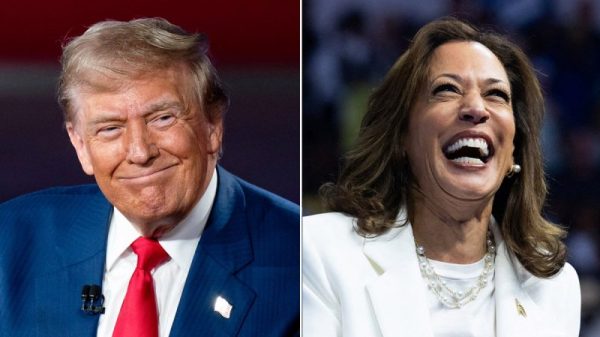
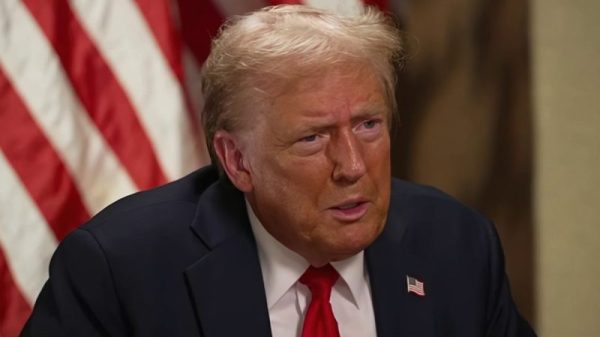
The sources are claiming that a US Supreme Court decision on President Donald Trump’s use of emergency tariff powers under the International Emergency Economic Powers Act (IEEPA) could jolt markets, especially if the tariffs are struck down.
They could address not only whether the IEEPA can be used to impose tariffs, but also whether importers could be reimbursed for tariffs already paid.
Even if the court restricts tariff authority, traders aren’t assuming the tariff story disappears.
The analysts argued that the administration has other legal avenues to pursue tariffs, suggesting the framework could end up resembling what markets already price in.
That’s why desks are treating the ruling as a volatility event: it could change the path, but not necessarily the destination.
Beyond policy, next week’s earnings calendar is another pressure point for sentiment, with Nvidia results viewed as a key read-through for AI demand and capex intensity.
Geopolitics remains a live variable as well, with crude already sensitive to Middle East headlines and any renewed energy spike feeding the inflation debate.
The post US stocks slip after weak GDP; Dow drops 166 points appeared first on Invezz