









Oil prices extended gains on Wednesday as tensions between the US and Iran escalated, raising fears of supply disruptions.
Renewed tensions have surfaced between the US and Iran following the US downing of an Iranian drone that was operating close to an American aircraft carrier.
Additionally, the Islamic Revolutionary Guard Corps of Iran issued a threat to seize a US-flagged tanker operating in the Strait of Hormuz.
Uncertainty warrants risk premium
Negotiations are continuing despite these events, according to President Trump. Additionally, the White House confirmed that US-Iran talks remain scheduled for Friday.
“Uncertainty about how these talks will play out means the market will likely continue to price in some risk premium,” Warren Patterson, head of commodities strategy at ING Group said.
At the time of writing, the price of West Texas Intermediate crude oil was at $63.82 per barrel, up 1%, while Brent was 0.8% higher at $67.85 a barrel.
Developments in Iraq also warrant attention, primarily due to rising tensions between the White House and the Iraqi government.
A significant point of contention is the push by Iraqi politicians to install Nouri Al-Malaki as the next prime minister.
The US administration views Al-Malaki as overly aligned with Iran, leading President Trump to threaten diplomatic and economic repercussions should his appointment proceed.
Iraq is the second-largest OPEC producer, pumping a little over 4.1 million barrels per day in December.
Source: Rystad Energy
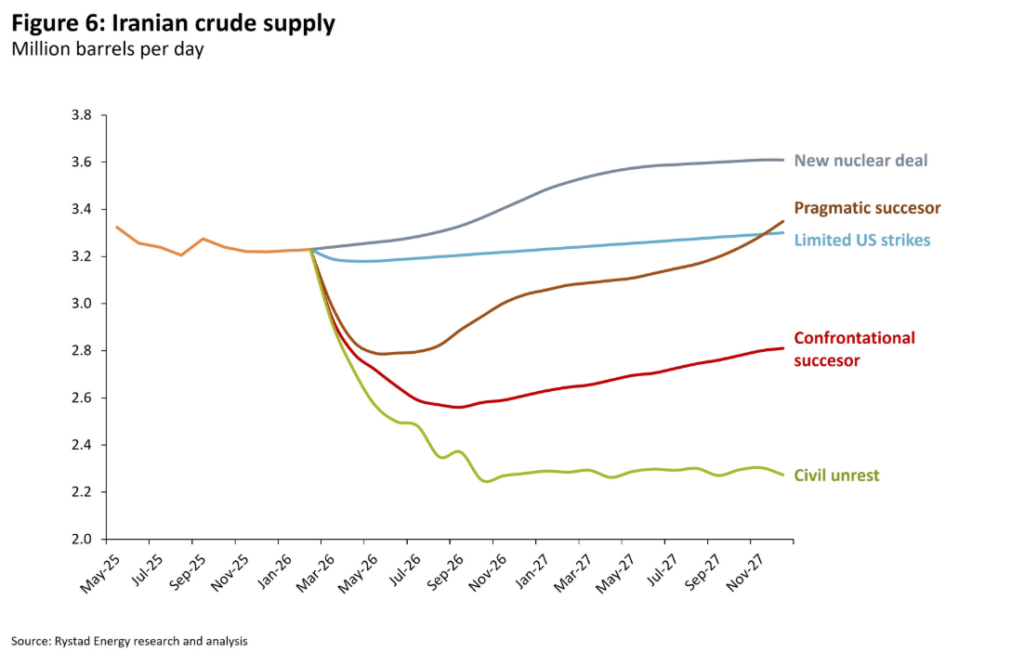
Scenarios emerging amid US-Iran tensions
“Five scenarios emerge as tensions rise between the US and Iran, with consequences for Iranian crude supply and global oil markets varying greatly,” Jorge Leon, senior vice president and head of geopolitical analysis at Rystad Energy, said in an emailed commentary.
The shift from a bearish to a bullish outlook could occur under several circumstances, Leon said. First, the two powers might agree to a new nuclear deal.
Second, the US could carry out limited strikes on Iranian military targets. Third, wider strikes targeting top Iranian leadership could be conducted, leading to their replacement by a new pragmatic or confrontational successor.
Finally, civil unrest within Iran could reach a critical point.
“Across all five scenarios, Iran’s significance within oil markets extends well beyond its own production profile,” Leon said.
The country’s geopolitical weight is rooted in its strategic location, its influence over regional security dynamics, and its capacity to disrupt critical energy infrastructure and transit routes.
Limited military action or a progressive shift towards diplomatic normalisation both significantly impact price formation.
This influence is channeled through alterations in the risk premium, volatility, and overall market confidence, Leon added.
Risks and impact
The oil market faces asymmetric risks, as demonstrated by the more severe scenarios.
While a renewed nuclear deal leading to additional Iranian supply would only result in modest, gradual downward pressure on oil prices, any escalation carries the potential for sharp, non-linear price responses.
Escalating geopolitical events, specifically those leading to sustained instability, closure of the Strait of Hormuz, or attacks on Gulf Cooperation Council (GCC) oil facilities, would fundamentally diminish the oil market’s capacity to manage disruptions, according to Rystad Energy’s commentary.
This is because such outcomes would deplete the spare capacity held by OPEC+, the Norway-based energy intelligence company noted.
In these scenarios, geopolitical risk transitions from being temporary to becoming a foundational, structural element of the global oil market.
The result would be a long-term outlook characterized by embedded higher prices, heightened volatility, and increased systemic fragility.
Rystad’s analysis of oil prices reveals a distinct asymmetry, with limited and gradual downside risks.
Should a new nuclear deal be secured, the addition of Iranian supply and the subsequent reduction in risk premium would likely lead to a modest decrease of about $5 per barrel.
Escalation scenarios, conversely, suggest larger and more rapid upward price movements.
A limited military action could introduce a short-term risk premium, pushing prices up by $5 to $10 per barrel, Rystad said.
However, a broader conflict scenario would likely trigger immediate price surges of at least $10, and potentially over $15 per barrel, driven by: immediate supply disruptions, threats to transit routes and infrastructure, and the resulting depletion of spare capacity, it added.
Inventory data boosts prices
Meanwhile, the oil market also received a significant lift following a highly bullish inventory report from the American Petroleum Institute (API) on Tuesday.
The report revealed a substantial draw in US crude oil inventories, which decreased by 11.1 million barrels last week, far surpassing the market’s expectation of roughly a 640,000-barrel decline.
In contrast, refined products showed mixed results: gasoline inventories rose by 4.7 million barrels, while distillate fuel oil stocks dropped by 4.8 million barrels.
“This reflects the impact of a recent winter storm hitting large parts of the US,” ING’s Patterson said.
The extreme weather impacted energy infrastructure, leading to increased heating demand.
The eagerly anticipated Energy Information Administration (EIA) report is scheduled for release later today.
Patterson said:
If EIA numbers show a similar drop in crude oil inventories, it would be the largest decline since June 2025.
The post Analysis: Oil extends gains as escalating US-Iran tensions threaten $15+ surge appeared first on Invezz