













In March, President Donald Trump announced the Air Force’s new F-47 stealth fighter, built by Boeing. So where is the Navy’s secret new carrier plane?
Fifteen years ago, the U.S. Navy read the signals from China and secretly started development of a long-range, stealthy plane to launch from aircraft carriers. The Navy’s newest bird is more like a fighter-bomber, with the AI smarts to lead drones into combat and enough range to scare China.
Today that plane – known only as F/A-XX or fighter attack, experimental – is ready to go. Both Boeing and Northrop Grumman have flown test planes. Their prototypes are waiting in the wings; or rather, in discreet guarded hangars, most likely in Missouri and Florida.
Yet, for some reason, the Pentagon isn’t in the mood to make the ‘downselect’ purchase decision. The delay is shocking and dangerous.
Congress wants the Navy plane so much they added nearly $1 billion to the budget to accelerate F/A-XX. ‘The U.S. Navy needs sixth-generation fighters. I’m concerned that any hesitancy on our part to proceed with the planned procurement of the sixth-gen fighters for the Navy will leave us dangerously outmatched in a China fight,’ Rep. Ken Calvert, R-Calif., the head of the House Appropriations Subcommittee on Defense, said on May 14.
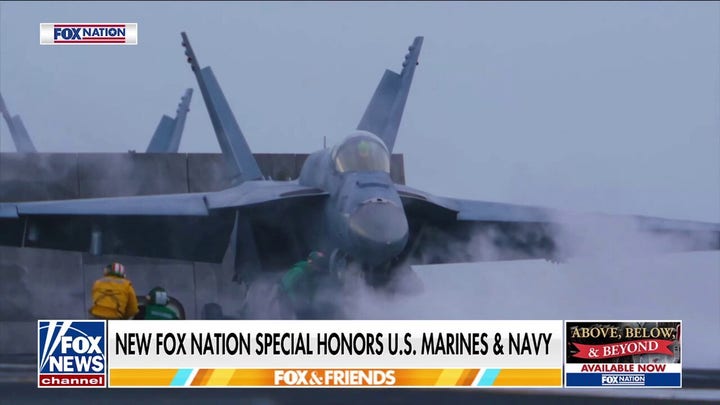
Of course, U.S. Navy F/A-18EFs have pounded Middle East targets during various air campaigns for almost three decades. Just look at the damage they did to Houthi missile sites and weapons caches in Yemen during Operation Rough Rider this past spring. But for the fierce fighting scenarios of the Pacific, the Navy pilots that fly from aircraft carriers need a new plane.
All that President Trump has to do now is take this opportunity to pick the best plane for the Navy.
Here are six things to know about the Navy’s secretive project.
The Navy has not let us see photographs of the F/A-XX, obviously. Tantalizing concept art released over the summer reveals a smooth stealth shape, with a cockpit canopy similar to the F-35. The diamond or delta-wing shape provides lift and range, especially at higher cruise altitudes.
In April, the Navy announced F/A-XX would have at least 25% more range than current fighters. The range could be up to 1,000 miles, according to a top analyst’s estimate. Add in air refueling, longer-range missiles, and you have the ability to take the fight all across the Pacific. I can tell you this: the Navy has been short of a true long-range fighter since the retirements of the A-6 Intruder and the F-14 Tomcat of TOPGUN fame, so range is a priority.
While the F-35C excels with just one engine, the Navy preference has always been for two engines, due to all that flying over water. You won’t see the engines because they are tucked inside the plane to diminish heat signature. U.S. engine technology is far ahead of China’s, in areas like thermal management and overall thrust.
Early stealth aircraft like the SR-71, F-117 and the B-2 sported flat black coatings to help absorb radar waves. The current trend in stealth materials is an avian grey, like the B-21 Raider bomber now in production. Fortunately, the U.S. is the world leader in aerospace-grade carbon fiber composites.
Expect an impressive bomb bay for internal carriage of long-range missiles. Current fighters like the Superhornet hang missiles from hard points under the wings. To achieve stealth, the FA-XX will follow the path of the F-35C, and tuck missiles inside. Sawtooth bomb bay doors help maintain the aircraft’s stealth profile.
Part of the Navy’s plan is to stock carriers with drone refuelers like the new MQ-25 Stingray to accompany the F/A-XX on its stealthy missions. Since you ask, no, drones cannot do it all. Naval strike demands payload to carry heavy bombs and missiles. Plus, it turns out a pilot is pretty useful. The FA-XX can also control wingmen drones in the battlespace. With FA/XX, the Navy can target enemy ships, land bases, and radar sites.
Trump certainly understands the value of stealth after the B-2 bomber’s obliteration of Iran’s nuclear sites. It’s unclear whether anyone has laid out for the president just how a massive risk the Pentagon is taking with naval aviation by slowing down F/A-XX.
Please note that China flew a stealthy demonstrator designed for carrier landings over a year ago. On Nov. 7, China commissioned its third carrier, the Fujian, and is laying modules for a fourth carrier — designed to be bigger than the USS Gerald R. Ford and to run on nuclear power for the first time. In a few years, China may have six of its own carriers. That’s a serious threat.
Put simply, the Navy must have this long-range, stealthy fighter. The idea is to pair the FA/XX with long-range missiles so the carrier airwing regains the long-range punch they will need to maneuver and strike against China in the Pacific.
No one wants to say this, but without FA-XX, the carrier mission may diminish in the future.
It’s past time for President Trump to make a decision.