














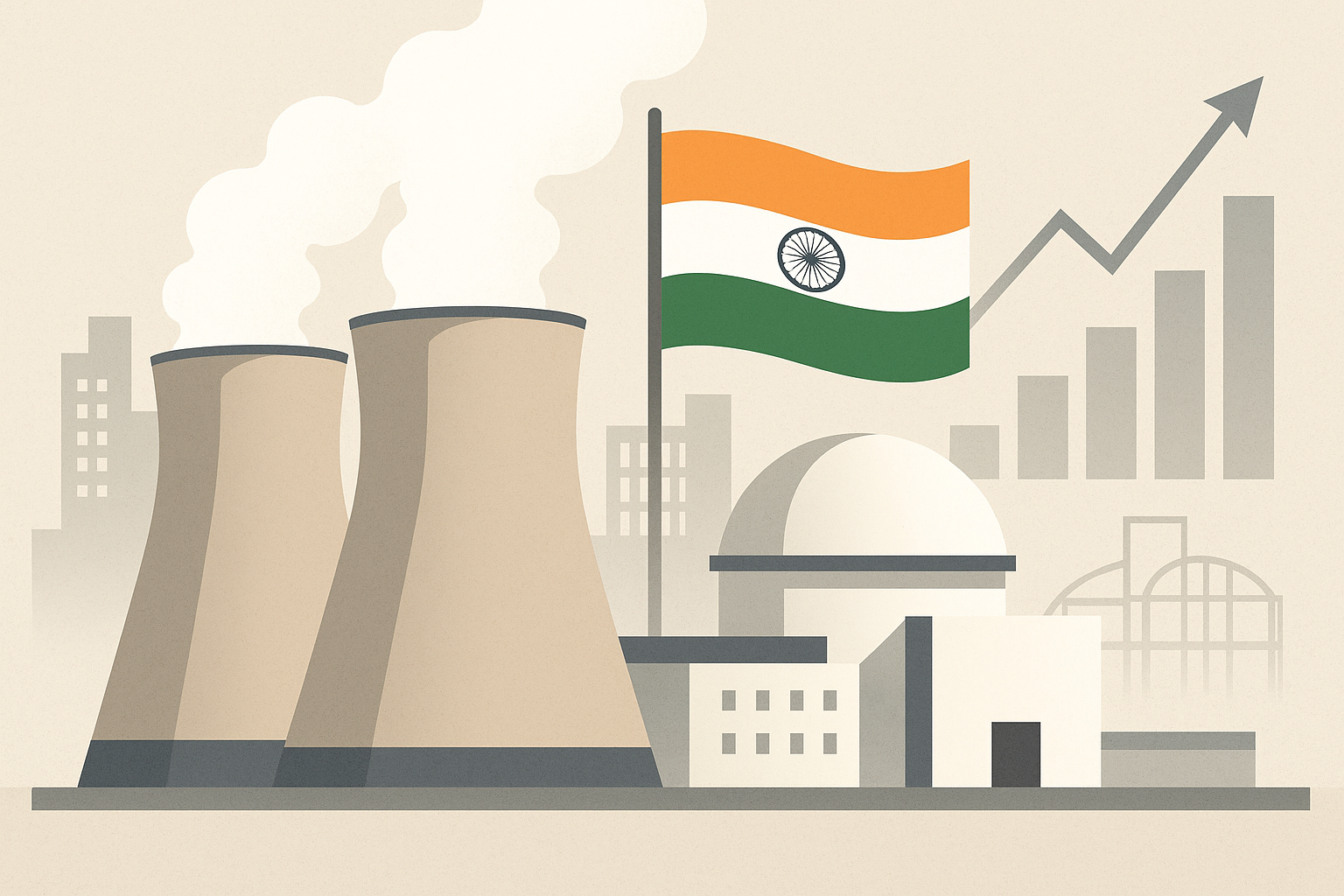

India is preparing a sweeping overhaul of its atomic energy laws that would, for the first time, allow private investment in nuclear power generation—marking a pivotal shift in the country’s energy strategy as global interest in nuclear accelerates.
The reform, which could unlock projects worth as much as Rs 19.3 trillion ($214 billion), is part of New Delhi’s broader push to expand clean-energy capacity and meet its long-term development goals.
The proposed bill is expected to seek cabinet approval this week before being introduced in parliament during the current legislative session ending December 19.
Jitendra Singh, the minister overseeing India’s atomic energy department, outlined the government’s intentions in an interview with Bloomberg News.
A major policy shift to attract private capital
The core objective of the new nuclear policy is to “facilitate the private sector, to bring in ease of business for them,” Singh said.
Currently, private firms in India’s nuclear ecosystem are restricted to supplying equipment, with generation remaining strictly under state control.
Prime Minister Narendra Modi hopes to change that by opening the sector to private participation as part of his plan to install 100 gigawatts of nuclear capacity by 2047, coinciding with his target to transform India into a developed economy.
However, India’s existing nuclear liability framework has long been a deterrent to foreign and domestic companies.
Unlike global norms, which place liability for accidents on plant operators, India’s unique law exposes suppliers to potential claims and litigation.
This has stalled major projects involving Electricité de France (EDF) and Westinghouse Electric Co., while prompting General Electric Co. to withdraw from supplying reactors altogether.
Modi has already signaled plans to amend both the atomic energy law and the liability legislation.
Singh declined to provide specifics of the new bill but confirmed that a comprehensive revision is underway to create a more “facilitative and easy to work with” regulatory environment.
India aligns with global nuclear revival
India’s push comes amid a renewed international embrace of nuclear power, driven by soaring electricity demand from artificial intelligence systems and energy-intensive data centers.
Nations such as Japan, China, South Korea, and Bangladesh are scaling up nuclear construction or restarting reactors to meet clean-energy needs.
India itself had been largely isolated from nuclear trade following its first nuclear test in 1974.
Although a landmark 2008 civil nuclear agreement with the US reintegrated the country into global atomic commerce, the supplier-liability rules that followed created new roadblocks.
As a result, several marquee foreign-led projects have remained stuck for years.
Potential expansion of Russian reactor projects
The Kudankulam nuclear plant in Tamil Nadu—the only Indian site using foreign technology—currently operates two Russian-designed 1-gigawatt reactors, with four additional units under construction.
The proposed legislative changes could pave the way for a second nuclear project involving Russian reactors.
According to Singh, both countries agreed to speed up site allocation during Russian President Vladimir Putin’s recent visit to New Delhi.
Discussions on the details of the expanded Russia–India nuclear collaboration are ongoing, Singh said, signaling further movements in India’s efforts to diversify partnerships as it ramps up its nuclear ambitions.
The post India moves to open nuclear power sector to private investment appeared first on Invezz